Amphibian Reforestation Monitoring
Since 2023 we have monitored amphibian community recovery across our restoration sites using a network of transects established in 10 m and 30 m spaced planting islands. Each transect spans both planted and interstitial space, allowing us to examine how fine-scale structural complexity shapes amphibian recovery over the course of restoration. Control transects in natural regeneration areas and remnant forest within the FCAT Reserve provide points of comparison. Every year, we conduct visual encounter surveys six times per transect, across both the dry and wet seasons. Over three and a half years of monitoring, we have recorded 4,622 individuals spanning 23 species. Abundance is dominated by the widespread generalist Pristimantis achatinus, but in the past year we have begun recording individuals of forest-dependent species in the restoration sites including the Critically Endangered Leucostethus bilsa, and the Endangered Leptodactylus peritoaktites. We are collaborating with thermal ecologists to better understand how temperature influences recovery rates of different species, and hope to incorporate acoustic monitoring to allow us to better detect cryptic species while scaling up our monitoring efforts.
Research Question
- What is the rate and extent of amphibian community recovery in tropical forest restoration?
- How do restoration planting decisions influence amphibian recovery?
- How does temperature influence amphibian species recovery?
Methods
We established 48 total amphibian monitoring transects in March 2023, one year after initial restoration plantings. We established 37 by 4 m transects in four planted islands in four parcels with 10 m (16 transects) and four parcels with 30 m (16 transects) interstitial spacing, respectively. Transects were aligned to contain 17 m within islands, and 10 m on either side in originally unplanted space. We randomly oriented all transects, and randomly selected the four islands to survey in 10 m spacing parcels to minimize potential bias in sampling design. We also established four equivalent transects in each of two reference forest (eight transects) and two natural regeneration (eight transects) control parcels. Control transects were randomly oriented and distributed within their respective parcel.
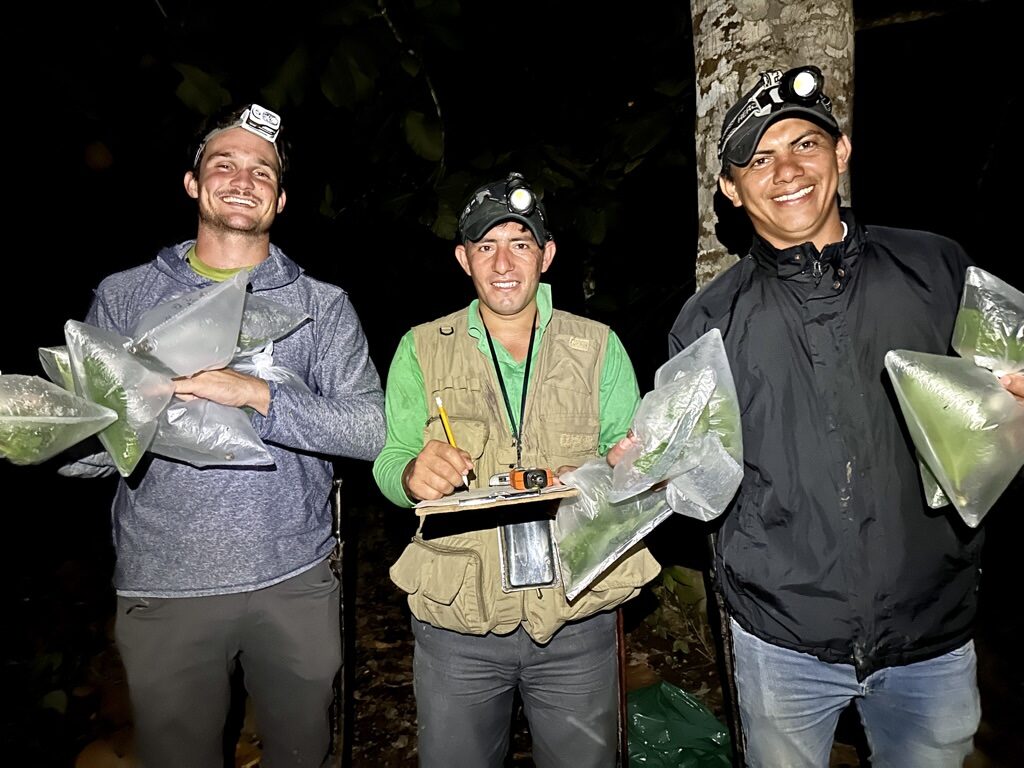
DZC and JCL perform visual encounter surveying for amphibians in all transects three times in the dry season, and three times in the wet season each year. All sampling occurs between 20:00 and 24:00, corresponding with peak amphibian activity hours. Observers search at a pace of 2.5 m per minute in each of the three sections (14:48 total search time per transect), recording the identification and number of each species of amphibian in each section. DZC and JCL take pictures of individuals representing each phenotype every sampling night, which are used to confirm species identification by SHJ and DFM.
Thus far we have used R and the vegan package to calculate abundance, richness, and diversity indices across sampling years and treatments.
Key Findings
Data collection is still in progress. But thus far we have begun to see individuals of forest-dependent species return after three years of forest restoration.