Avian Seed Dispersal and Restoration
In early successional tropical forests, plant diversity, phenology, and fruit availability strongly shape frugivorous animal composition. In turn, the composition of frugivorous animals determines the spatial distribution, quantity, and composition of dispersed seeds across tropical landscapes, as over 85% of plant species in these regions rely on frugivorous animals to disperse their seeds. These mutualistic feedbacks facilitate the formation of dynamic interaction networks that continuously restructure to influence establishing vegetation and frugivore communities through time. Therefore, this work aims to link the development of seed dispersal network structure to the assembly of establishing vegetation and frugivore communities through time to understand mutualistic feedbacks during tropical forest succession. We will do this by leveraging the Choconexion experimental restoration initiative. Through manipulating early successional vegetation structure, we will empirically test drivers of mutualistic interaction emergence via network analysis, how plant-frugivore networks restructure as forest succession progresses, and how this restructuring of interaction networks influences resultant plant and frugivore community structure through time as forests continue to grow and restructure with forest succession.
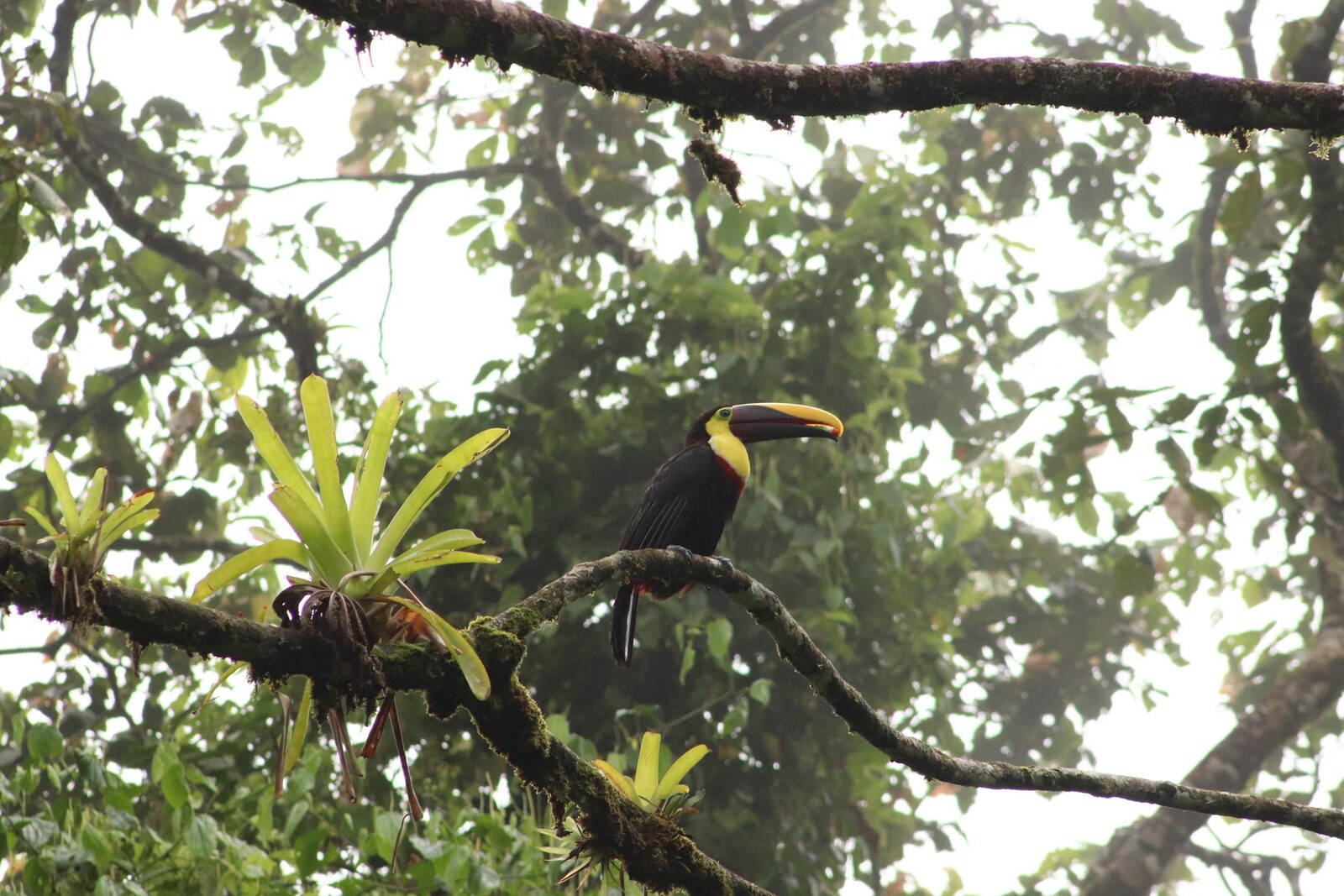
Research Question
- How does early successional vegetation influence frugivore community assembly?
- How does early successional vegetation influence the reassembly of seed dispersal interactions?
- How does the reassembly of seed dispersal interactions feed back to structure resultant early successional communities?
Methods
- To test how early successional vegetation structure drives frugivore community assembly and how these communities generate seed dispersal networks, we are sampling for interactions in all 12 experimental plots and 4 controls.
- Within each plot and control, we quantify frugivore assemblages and seed dispersal interactions using mist-netting for birds.
- Bird mist-nets are operated for two consecutive days per sampling period, from 0700–1200 h, coinciding with peak avian activity. All individuals are banded with uniquely numbered aluminum leg bands and measured for morphological traits (e.g., mass, wing chord) to enable trait-based analyses of community assembly.
- To directly quantify seed dispersal interactions linking frugivores to plant recruitment, each captured bird is temporarily held (~10 min) in a clean cloth bag to collect fecal samples. These samples are used to reconstruct plant–frugivore interaction networks via seed identification.
- We will then use these data to test how variations in the restoration plantings influence avian communities and seed dispersal interaction formation and structure through time.
Key Findings
- Forest structural complexity interacts with species traits to determine how functionally spread out and differentiated avian communities are across successional stages, and should play a significant role in determining which restoration plots birds are most attracted to.
- Early successional vegetation that is naturally regenerating can foster a high frequency and diversity of seed dispersal interactions.
- As forests transition into secondary forests, seed dispersal interactions restructure, mostly driven by species turnover across habitats. Due to this restructuring, networks shift from loosely connected and highly diverse generalist-dominated systems in early stages of forest succession to more specialized and modular interactions in mature forests.
- Interaction loss and replacement across regenerating forests led to the emergence of more complex and structured seed dispersal networks as forests age.