Monitoring birds in regeneration plots using point counts
Monitoring bird communities provides a useful surrogate to understand the outcomes of habitat recovery after assisted and natural restoration. In order to assess temporal changes in community composition, bird species richness and abundances in regeneration plots, we undertook bird point counts from November 2022 to December 2025. We set up six point counts in each of the two experimental regeneration parcels. In each point count we undertook 10-minute counts of all birds observed, estimating distance to the nearest 5 m within a 50-m radius and estimating height above the ground. Each point count was surveyed 216 times in the 3-year study period, including 108 surveys in the rainy season and 108 in the dry season. Overall, we found 202 species, with a yearly increase in species richness. Regeneration plots were dominated by species tolerant to degraded areas (e.g., omnivorous tanagers, sallying flycatchers, granivorous seedeaters). Yet, point counts that experienced a marked growth of secondary vegetation or point counts situated closer to forest borders had more forest-based species (e.g., bark-searching and understory insectivores, forest-dependent frugivores). Beyond collecting bird data, the project aimed to train FCAT field members in bird surveying and identification, an objective that was successfully accomplished through the surveying time.
Research Question
We aimed to understand how bird communities respond to habitat changes after natural and assisted restoration, both in species richness, community composition and abundance. We hypothesized that bird species adapted to degraded habitats will progressively be replaced by more forest-dependent bird species with changes through time in vegetation cover and structure.
Methods
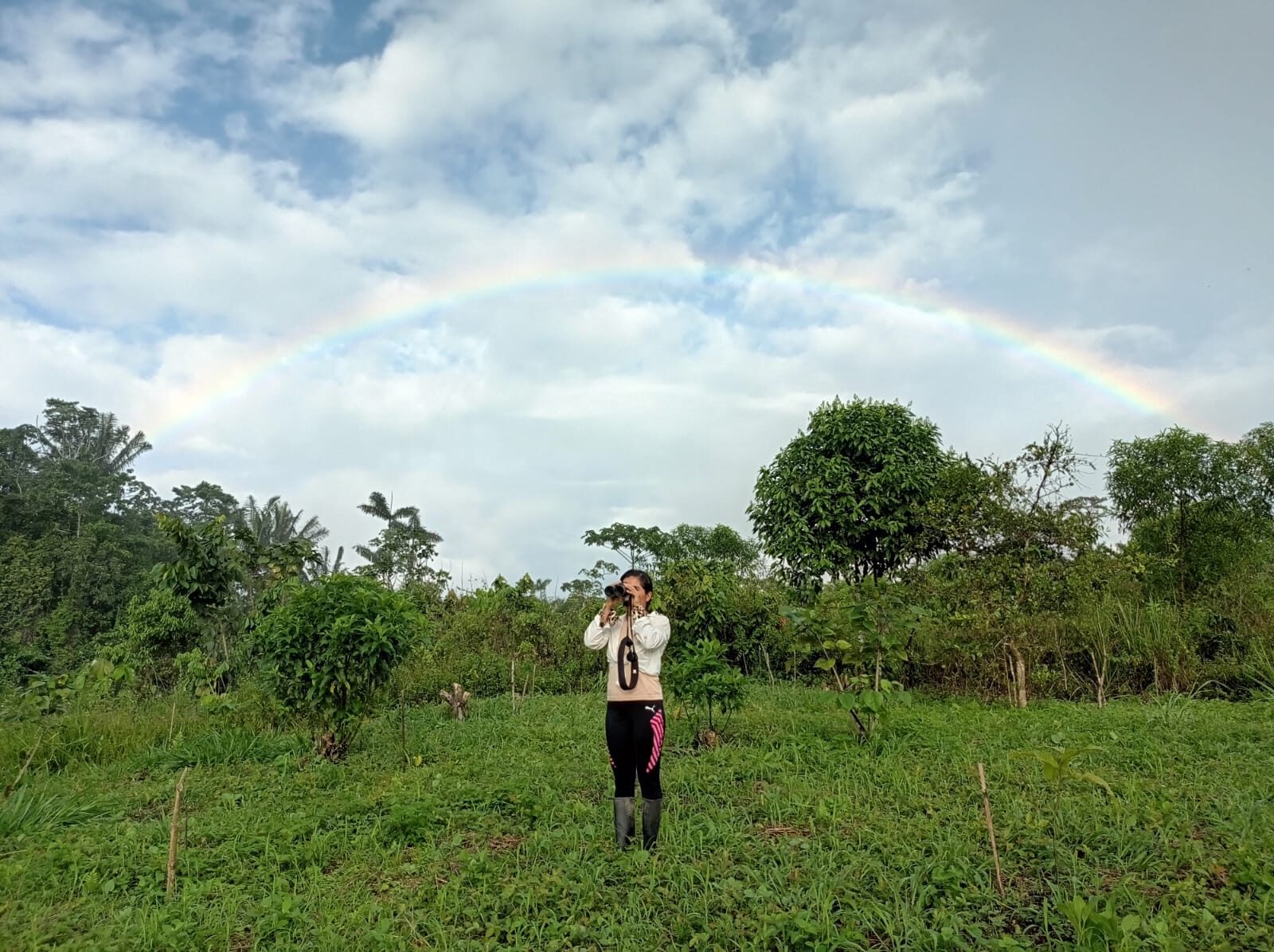
We established 12 point counts, six in each experimental regeneration parcel. Point counts corresponded with experimental regeneration plots 1–13. In each point count we undertook 10-minute counts of all birds observed, estimating distance to the nearest 5 m within a 50-m radius and estimating height above the ground. Bird counts were carried out simultaneously by three observers.
Surveys were carried out in 6 point counts in the morning (6h30–9h30) and 3 point counts in the afternoon (15h30–17h30), alternating the surveying sequence in order to start each observation day at a different point count. Every year, we completed 24 days in the rainy season (January–June) and 24 days in the dry season (July–December). Overall, each point count was surveyed 36 times in each season per year. This information is currently under analysis for species richness, community composition and abundance.
Further, we used point count sampling as a means to simultaneously train two local researchers in bird surveying and identification. Training was performed directly in the field and in office sessions using updated field guides and online resources. Initially, species identifications in the field by apprentices were corroborated by the professional ornithologists, but corroboration was progressively abandoned as field assistants learnt how to identify and count birds.
Key Findings
Overall, we found 202 bird species, 45% of which are typical of regenerating habitats, 38% of degraded habitats, and 17% of forest. The bird community in regenerating parcels was dominated by insectivorous and omnivorous species in the Thraupidae (tanagers) and Tyrannidae (flycatchers) families (one out of four species). Further, the 10 most abundant species accounted for the majority of detections, with three tanager species (Flame-rumped Tanager Ramphocelus flammigerus, Blue-grey Tanager Thraupis episcopus, and Palm Tanager T. palmarum) being the dominant species throughout the study period.
Even though data is still being analyzed, a few remarkable qualitative observations include an apparent increase through time in richness and abundance of forest-dependent species (bark-searching or terrestrial insectivores) and a decrease in species strongly associated with degraded habitats (granivorous seedeaters). These changes are likely associated with changes in the vegetation structure of the study plots. We also noted seasonal variation in detections of some species that likely engage in local migrations (White-browed Gnatcatcher Polioptila bilineata, Chestnut-headed Oropendola Psarocolius wagleri), as well as increases in detections of some species associated with flowering or fruiting of key resources.
Notably, 32 species classified as threatened or near-threatened in Ecuador were found and 8 species classified as globally threatened or near-threatened. The most remarkable records include the Ecuadorian endemic Lilacine Amazon Amazona lilacina and the Choco endemic Long-wattled Umbrellabird Cephalopterus penduliger, both detected only once across the study period. The 3-year study period allowed local researchers to develop skill and knowledge in bird surveying and identification.