Lekking Manakins and Forest Recovery: Linking Behavior, Seed Dispersal, and Succession
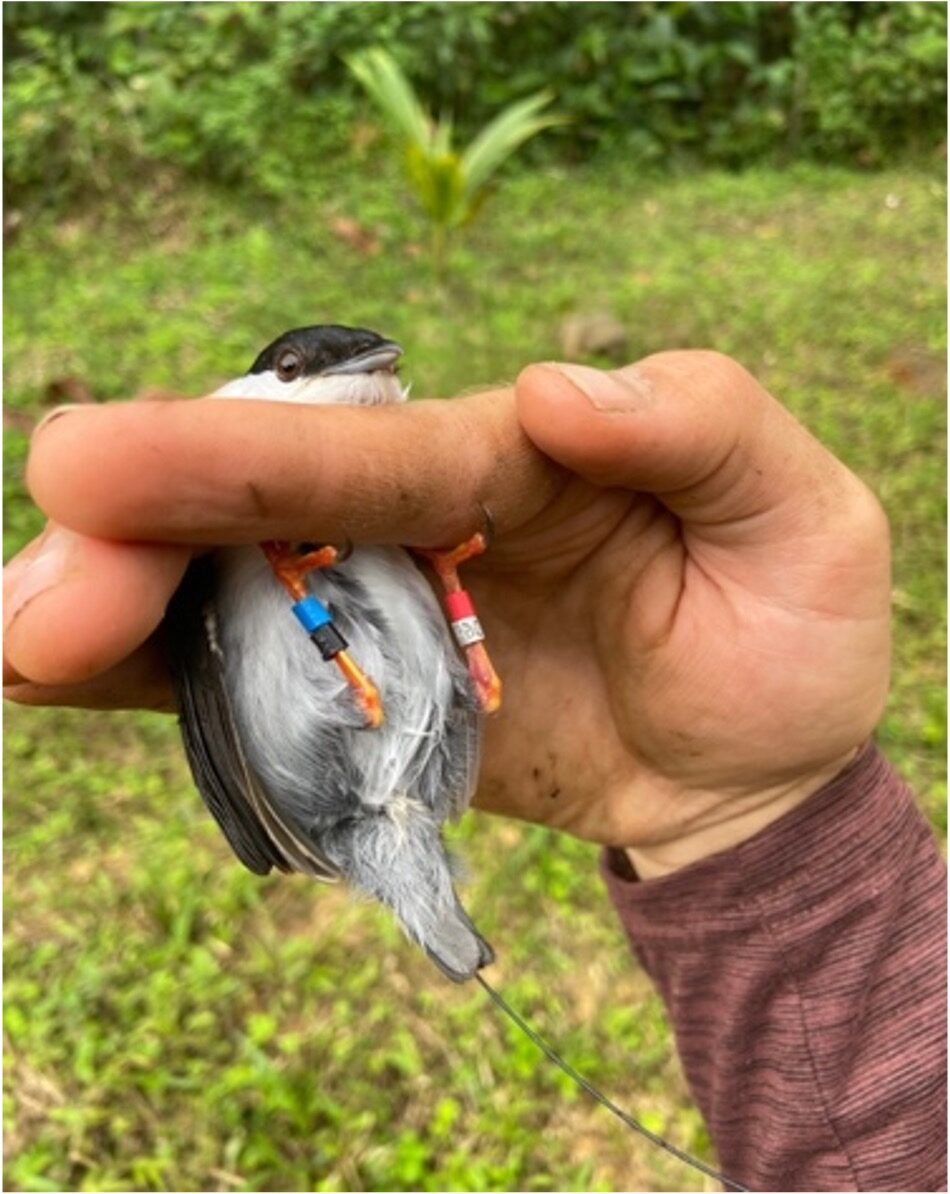
White-bearded manakins (Manacus manacus) are frugivorous (fruit-eating) lek-breeders, meaning males gather in space to perform complex mating displays for females. These gatherings – which occur at traditional sites called leks – provide a unique opportunity to study how a single species contributes to forest recovery. In this project, we are leveraging lek formation event(s) within the Choconexion project area to identify the importance of existing fruit resources on lek site selection. Given that males perform energetically costly displays and spend much of the day within lek boundaries, we hypothesize that leks will form in areas with high levels of pre-existing fruit availability. Using camera traps and direct behavioral observations, we are further identifying the influence of surrounding fruit resources on individual-level male mating success. Following lek formation, we are investigating the ways in which lek presence influences forest recovery trajectory. Given that leks are highly stable over time, we hypothesize that lek presence will result in regeneration “hotspots” where males perform concentrated seed deposition. To test this hypothesis, we are performing radio telemetry to describe the sex-specific movement patterns of manakins in relation to existing fruit resources and lek position. We are also monitoring seedling survival and fruit availability at lek and non-lek sites over time to identify how lek presence ultimately facilitates forest recovery and succession.
Research Question
Primary question:
- How does manakin lekking behavior influence successional trajectory and contribute to forest recovery?
Constituent questions:
- How does existing fruit distribution influence lek formation and resulting lekking dynamics?
- How is manakin movement behavior affected by ecological (e.g., distribution of fruit resources) and social (e.g., lek mating system) context?
- How do movement patterns and manakin diet combine to shape seed deposition patterns?
- How does seed dispersal by manakins impact seedling survival, plant distribution, and fruit availability as forest recovery progresses?
Methods
Data collection is primarily performed by FCATeros Jairo Cabo and Belén Casanova.
- Lek establishment: We perform twice-monthly lek establishment surveys throughout the study area to identify the formation of new leks and constituent display courts. These surveys include both auditory (e.g., listening for characteristic manakin display sounds such as wing-snaps, grunts, and calls) and visual (e.g., searching for manakin display courts – cleared areas on the forest floor surrounded by small saplings) sampling.
- Behavioral observations: We use camera traps located at display courts to characterize individual male display rate and mating success. We also perform monthly lek-level activity surveys in 30-minute sessions to quantify broad-scale display behavior.
- Fruit availability: We perform monthly fruit availability surveys at manakin display courts, control points located 25 m from each display court, and landscape-level background control points throughout the Choconexion study area. In these surveys, we measure the abundance and diversity of small fleshy fruit consumed by manakins within a 10-m radius circle. We also measure habitat structure (e.g., canopy height, canopy openness) twice-annually at these fruit monitoring points.
- Radio telemetry: At approximately 6-month intervals, we track the movement of tagged individuals by attaching small tracker “backpacks” to a subset of manakins within the study area. While the “backpacks” are attached, we use on-the-ground tracking to estimate manakin location at 5-minute intervals within 1-hour tracking sessions. This radio telemetry work is supported by FCATero Jorge Olivo.
- Seedling plots: We perform twice-annual surveys of vegetation plots at lek and non-lek locations to characterize floristic community dynamics over time. At these plots, we identify and track individual plants to monitor seedling establishment, survival, and recruitment to adulthood.
Key Findings
Data collection in progress.