Estimating Fruit Availability by Measuring Plant-Emitted Gases
The smells of the forest come from plants emitting different gases — from fruits, flowers, and leaves — and go on to react in complex chemistry in the air. Birds and other animals use these scents, along with their other senses, to identify where food or shelter may be. Traditional methods of surveying fruit or food availability are time consuming and labor intensive. We are therefore testing whether the scents of the forest can be collected to estimate fruit availability, as well as to better understand the spatial distribution of these gases and their chemistry. We are developing approaches to passive air sampling to collect gases over weeks or months with low effort for analysis in the lab. Results will be used to better understand the food systems within the forest ecosystem as well as the impacts of plants on the regional atmosphere.
Research Question
- How are terpenes and other plant emissions spatially distributed in a tropical ecosystem? How does diversity correlate (or not) with distance?
- Which gases provide quantitative estimates of availability and density of different fruits in the Choco ecosystem?
Methods
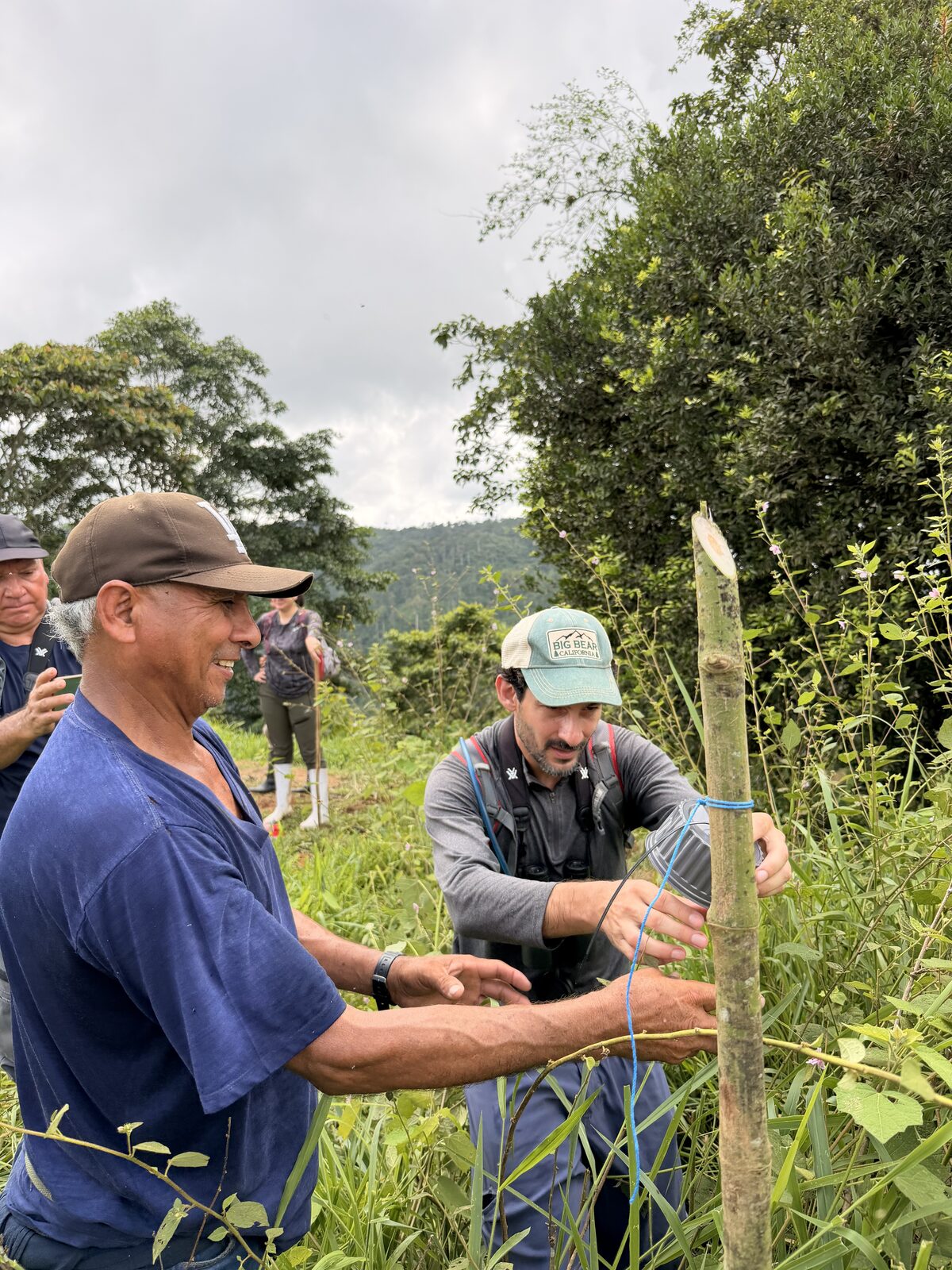
- Tubes containing polymer sorbents are deployed as passive samplers (approximately following US EPA Method 325B). Samples are deployed at 50 sites co-located with fruit and bird surveys.
- Samples are left at the site for 4 weeks.
- Samples are analyzed by thermal desorption gas chromatography/mass spectrometry. Concentrations are quantified for monoterpenes, sesquiterpenes, and oxygenated compounds.
Key Findings
Work still in progress. Preliminary data has found sesquiterpene concentrations are strongly correlated with fruit density, as well as a small number of specific oxygenates. Terpene diversity is not correlated with distance between sites, with composition varying over very short distances.