Woody plant community reassembly
This project evaluates changes in woody plant regeneration through time (2024–2029) in relation to experimental forest restoration. Our expectation is that planted pioneer trees like cecropias and figs will produce copious fruits that will attract fruit-eating animals to a greater degree than alternative tree plantings that do not include these species. As they move through the landscape, fruit-eating animals will disperse the seeds of rainforest plants. Experimental plantings will also generate variation in light, temperature, humidity, and soil quality; these environmental conditions will act as filters allowing only the best-adapted plant species to regenerate. Between seed dispersal and environmental filtering, we predict that seed dispersal opportunities will be more important in determining the species composition of regenerating rainforest plants. If so, FCAT and other conservationists may save time and money by planting a smaller number and diversity of fruit-producing trees to restore Chocoan rain forest.
Research Question
- How do tropical rain forests reassemble themselves after agricultural destruction?
- Which processes are most important for predicting woody plant species composition, seed dispersal or environmental filtering?
- What are the most efficient restoration strategies for restoring rain forest in the Ecuadorian Choco?
- Can conservation organizations plant a small number of fruit-producing trees and achieve the same (or better) forest recovery compared to projects that plant more trees and more species?
Methods
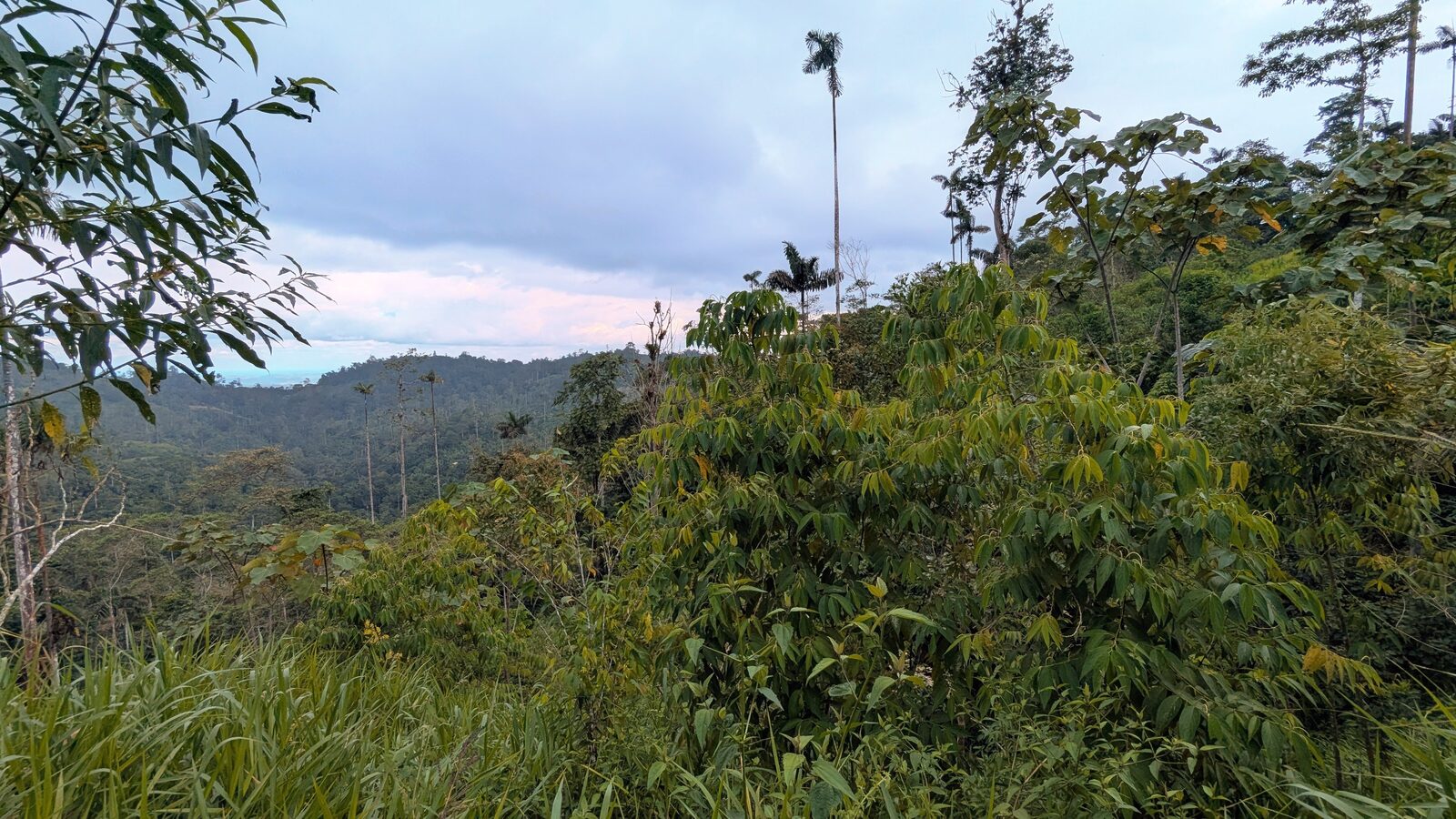
To study woody plant community reassembly, we are monitoring woody plants in 192 circular plots distributed throughout the Choconexion Experimental Landscape. Baseline plant community monitoring included species identification and abundance and was completed in 2024 and will be repeated in 2029.
Within each experimental plot (N = 16) twelve monitoring stations are distributed in two diagonal transects, forming an X across the plot. At each station (marked with a gray PVC pole and reflective tape), woody plants are identified and counted within variable-sized radii depending on the plant size. Within two meters of the PVC pole, all woody plants 10–50 cm in height are measured. Within a three-meter radius, woody plants 51–137 cm in height are measured. Within a four-meter radius, woody plants 0–10 cm diameter at breast height are measured. Larger woody plants are measured across each 1.56-hectare plot.
These radii (2, 3, 4 m) correspond to 12.6, 28.0, and 50.3 m². Together, the 12 stations in each plot represent 1.0, 2.2, and 3.9% of each 1.56-hectare plot. Seedlings are identified morphologically in the field and by collecting voucher specimens for herbarium identification at QCNE.
Key Findings
Two years after cattle were removed there was substantial baseline variability in woody plant diversity and composition across the Choconexion Experimental Landscape. Across all sixteen plots, we identified 319 taxa, of which 212 (64%) were identified to species, 84 (26%) to genus, and 4 (1%) to family, with 19 (6%) undetermined. In individual plots, observed richness ranged from 0 to 20 taxa, with the greatest richness in two old-growth forest controls. Despite high variability, there was no clear pattern in baseline richness or composition among experimental plots in the degraded pasture.